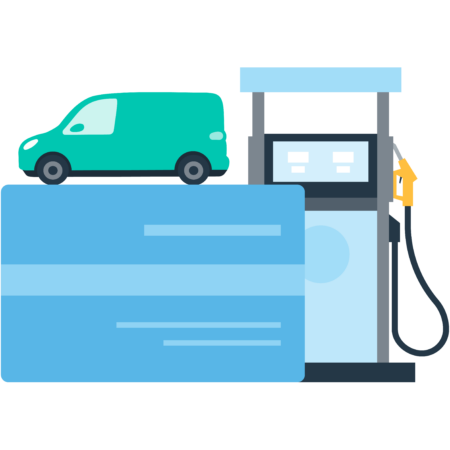
A fuel card is a specialised payment card designed specifically for purchasing fuel, managing a fleet and, in many cases, vehicle-related services. Unlike a regular credit card that you might use for anything from coffee to office supplies, a fuel card is purpose-built for managing vehicle expenses.
Fuel cards work similarly to credit or debit cards, but they come with built-in controls and reporting features that make them particularly useful for businesses. When your driver pulls up to a service station, they present the fuel card, pump the fuel, and the transaction gets recorded with detailed information – time, location, amount, even the vehicle identification number in some cases. This data then flows directly into your accounting system, eliminating the need for paper receipts and manual expense reports.
How do fuel cards work?
Using a fuel card is straightforward. Your driver inserts the card at the pump terminal, enters the driver ID, and selects the fuel type. Some cards require additional information like odometer readings, which might seem like an extra step but actually provides valuable tracking data for vehicle efficiency.
The billing process is where fuel cards really differentiate themselves. Instead of charging each transaction individually to your bank account, fuel card providers typically consolidate all purchases into a single invoice weekly, fortnightly, or monthly, depending on your arrangement. This makes reconciliation significantly easier compared to sorting through dozens of individual credit card transactions. The invoice includes granular details: which vehicle fuelled up, where, when, and how much they spent.
Key Fuel Card Benefits
Fuel cards strip away that complexity, giving you the control, visibility, and efficiency you need to keep your business moving forward. Here’s how the right fuel card solution can set your fleet operations.
Did you know? Unlike single-brand cards, WEX Motorpass is accepted at over 95% of service stations Australia-wide.
The primary fuel card benefit is cost control and savings. You can set spending limits per card, per day, or per transaction. Some cards allow you to restrict purchases to fuel only, preventing drivers from buying unrelated items. Businesses using fuel cards can reduce their fuel bills through better monitoring and fraud prevention.
Reporting capabilities & tracking
Reporting capabilities are another major advantage. Fleet fuel expenses typically account for 20% to 40% of total operating costs, so having clear visibility into where that money goes matters. Fuel cards provide detailed transaction data that helps you spot anomalies like a vehicle that suddenly starts consuming more fuel than usual, potentially indicating maintenance issues or unauthorised use.
Reduced internal administration and improved business efficiency
Administrative reduction is substantial. Without fuel cards, you’re collecting receipts, manually entering data, and trying to match transactions to vehicles and drivers. With fuel cards, the data flows automatically into your systems. Reporting data can often be viewed through online portals or mobile apps where you can review transactions in real-time, download reports, and adjust card settings without making a phone call. Understanding your fuel cards reporting capabilities is an important factor to consider, with WEX Motorpass®, ATO compliant statements, transaction data, annual and quarterly reporting are conveniently accessible on your online account.
Greater control and reduced risk
Preventing unauthorised transactions is increasingly critical. Operation leaders estimate that 19% to 22% of a fleet’s annual fuel consumption is lost to theft and fraud, including unauthorised fuel card use and skimming. Fuel cards with PIN protection, transaction alerts, and the ability to immediately freeze lost or stolen cards provide substantially better security than petty cash or shared credit cards.
What are the different types of fuel cards?
Multi-brand fuel cards – WEX Motorpass
A multi-branded fuel card, such as the WEX Motorpass, can be used at a wide range of branded and independent service stations. By choosing a multi-branded fuel card, the cardholder isn’t bound to a specific fuel station brand. This allows for more choice when filling up the vehicle and saves time and money in the long run because it’s quick, easy and convenient to find a participating fuel station.
Single-brand fuel cards
Single-branded fuel cards limit the cardholder to a specific service station network. Drivers are often inconvenienced when searching for a specific fuel station to refill and could end up spending time and fuel trying to locate a service station where their card can be accepted.
Features
Multi-Brand Fuel Cards
Single-Brand Fuel Cards
Network access
Wide range of branded and independent service stations
Limited to specific fuel station brand only
Driver convenience & Time efficiency
Quick and easy to locate participating stations anywhere
Drivers may spend extra time and fuel searching for accepted locations
Route flexibility
Drivers can refuel at convenient locations along any route
Routes may need planning around specific station locations
Reporting capabilities
Comprehensive reporting including ATO compliant reports with transaction data, spending insights, exception alerts, and customisable reports to track fuel usage and driver behaviour.
Basic transaction history; limited insight into spending patterns and fleet behaviour
Cost impact
Saves money by reducing detours and wasted fuel
May increase costs due to detours to find accepted stations
Best suited for
Fleets that operate across varied routes and regions
Fleets with fixed routes near specific station networks
Real-World Applications
For small businesses – say, a construction company with three vans, fuel cards eliminate the hassle of drivers paying out of pocket and waiting for reimbursement. You issue each driver a card with appropriate limits, and at month’s end, you receive one consolidated invoice with a complete breakdown. You can quickly identify if one vehicle is consuming significantly more fuel than the others, prompting a maintenance check.
Larger fleets benefit even more substantially. The Australian fleet management market is increasingly utilising big data and analytics alongside fuel cards to optimise operations. Effective fleet management through the use of fuel cards can expect to see a ROI on their fuel card, driven by reduced administrative costs, better fuel pricing, and fraud prevention.
The global fleet card market, valued at USD 1.19 trillion in 2026, is projected to reach USD 2.14 trillion by 2032, growing at 10.4% annually. This growth reflects increasing recognition of how fuel cards deliver measurable value.
Potential Limitations
Some cards limit you to specific fuel station networks, which can be inconvenient if your drivers frequently travel to remote areas. Card fees vary – some providers charge monthly fees per card, transaction fees, or both. You’ll need to calculate whether the benefits outweigh these costs for your specific operation. WEX Motorpass offers a wide range of benefits, minimising disruptions to your operation.
There’s also an implementation period. You need to distribute cards, train drivers on proper usage, and integrate the card system with your existing accounting processes. For very small operations, the administrative overhead of managing a fuel card programme will need to be considered.
Ready to Simplify Your Fuel Management?
If you’re spending too much time sorting through fuel receipts and wondering whether your vehicles are operating efficiently, it’s worth exploring fuel card solutions. WEX offers Motorpass, designed to help businesses gain better control over their vehicle expenses with detailed reporting, flexible controls, and streamlined billing.
Managing a fleet doesn’t need to be complicated. With the right fuel card solution, you can reduce administrative burden, improve cost control, and gain insights that help you run your vehicles more efficiently. Apply for Motorpass today and take the first step towards smarter fuel management.
FAQs
Can I get a fuel card for personal use?
In Australia, it’s challenging for a private individual to obtain a traditional fuel card, as these products are designed almost exclusively for businesses. To qualify, you generally need an Active Business Number (ABN) – but the good news is that sole traders, freelancers, and side-hustlers with even just one vehicle can apply.
Is it worth getting a fuel card?
Fuel cards tend to strip away complexity and deliver the strongest return on investment for businesses with commercial vehicle fleets and high fuel volumes. If you’re managing multiple vehicles and want to simplify payments, tracking, and reporting whilst reducing costs, a fuel card can be a worthwhile tool to keep your business moving forward. Consider your specific operation, evaluate your monthly fuel spend, the time your team currently spends on expense reconciliation, and whether streamlined reporting would benefit your tax compliance processes.
What are the benefits of a fuel card?
Fuel cards offer several key advantages for businesses and frequent drivers:
Cost savings – Fuel cards can provide consistent savings on fuel costs, helping to reduce one of the largest expenses associated with operating vehicles.
Wide acceptance – Many fuel cards are accepted at extensive networks of fuel stations, adding convenience and flexibility for drivers across multiple locations.
Simplified expense management – Fuel cards consolidate fuel, oil, and even repair costs into a single account, significantly reducing paperwork and administrative burden.
Improved tracking and control – Businesses can more effectively track, monitor, and control spending across their fleet, providing better visibility into fuel consumption and costs.
Easier tax reporting – By consolidating vehicle-related expenses, fuel cards can streamline tax reporting processes and make reconciliation simpler.
Additional perks – Some fuel cards include added benefits such as roadside assistance or discounts for automotive services.
Where can I use a fuel card?
You can use your WEX Motorpass fuel card at the vast majority of service stations across Australia. It’s accepted at approximately 93–95% of petrol stations nationwide, covering 6,500 locations. This makes it one of the most widely accepted fuel cards in the country, ensuring you’ll rarely be far from a participating station.
Beyond fuel purchases, your card works with partner businesses for:
Vehicle servicing
Tyres
Batteries
Accommodation (depending on the provider)
To help you locate the nearest accepting station and compare fuel prices while on the road, check out our WEX Motorpass Locations or Driver App – both make finding participating locations simple and straightforward.