




Stay connected
Subscribe to our Inside WEX blog and follow us on social media for the insider view on everything WEX, from payments innovation to what it means to be a WEXer.

In many industries, the cost of paying employees is the largest percentage of the annual budget. Trucking is no different: the people who drive the trucks require wages. The second largest budget item is fuel. So how do carriers manage fuel costs, and what does it look like in this era of spiked oil demand and economic uncertainty? How do fuel cards help the trucking business manage those costs? On a recent Petro Talk episode, hosts Ori and Tal Ezra were joined by WEX’s VP, national accounts, Matt Crumpton, to discuss the industry, and why fuel cards are so important to the work of an OTR leader. Here, we’ll explore why partnering with a fuel card company is a top priority for OTR businesses.
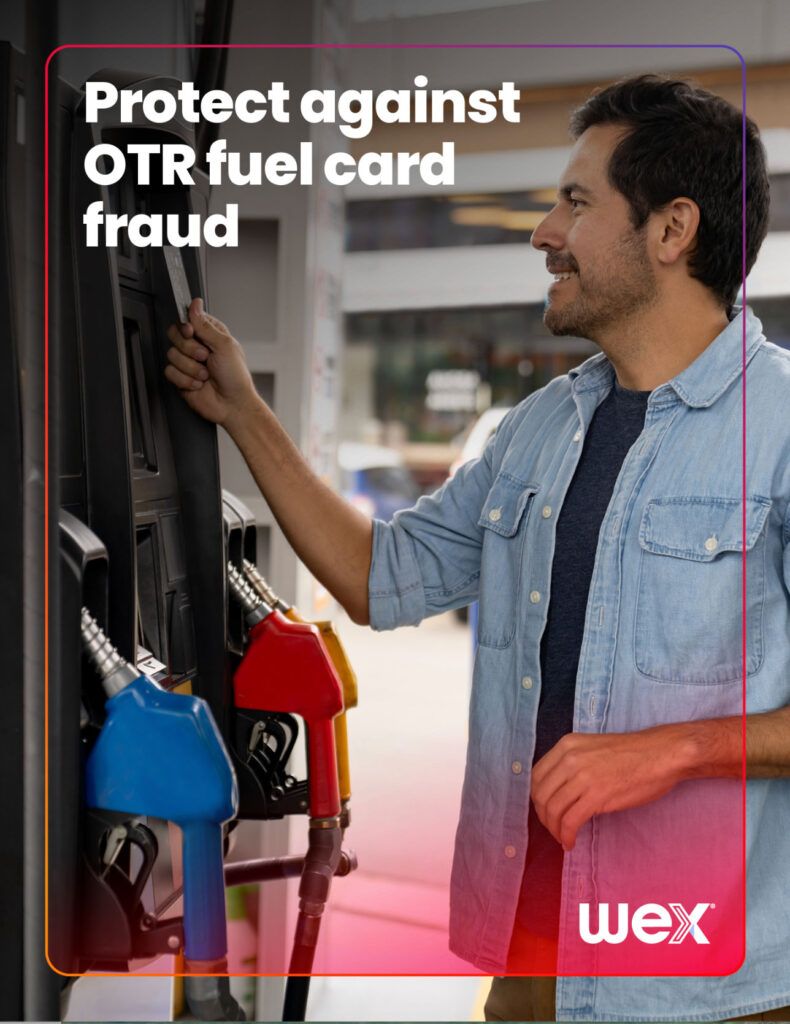
Protect your trucking business from fraud. Download our white paper today.
OTR businesses partner with fuel card companies to monitor card use: how much they’re spending, and on what items. On Petro Talk, Crumpton explained: “When your drivers use fuel cards, you know where your driver is fueling, what fuel they’re fueling, what grade of fuel they’re fueling, who approved it, and if other items beyond fuel were part of the transaction. With fuel card data, especially with card companies that provide Level III data, you’re provided with a holistic view of the spend allowing you to best maintain control.” In this era of high fuel prices, tariffs, and global economic uncertainty, visibility and control over where your dollars are going is a top strategic priority.
Another current economic issue impacting the trucking industry is a driver shortage. In 2021, the American Trucking Association (ATA) estimated that the trucking industry was short upward of 80,000 drivers and was trending toward a shortfall of 160,000 drivers by 2030. On May 14, 2026, the U.S. Department of Labor’s Office of Foreign Labor Certification issued guidance for the OTR industry that an English language proficiency test is now required when hiring new drivers. In the year prior to this legislation, approximately 18% of U.S. truck drivers were foreign-born. In an already strained workforce market, now truck drivers face new requirements to engage in their profession — a strain Crumpton has been hearing about from the carriers he works with.
Because of the driver shortage, industry leaders need to work harder than ever before to keep their staff happy. They’re looking at all the hurdles drivers face in their work and are focused on minimizing those barriers.
The fueling experience is one way trucking companies can simplify a driver’s day. Larger trucking companies provide a home terminal for truckers to fuel up before going out on the road. Over the years, Crumpton has consistently heard from customers that in an ideal world, the driver experience pumping at a truck stop is identical to the home terminal experience.
Home terminal fueling happens at the carrier’s own facility — a private fuel island on company property. Crumpton explains, “Anything that causes disruption to a driver’s day — from having difficulty purchasing fuel to any number of other difficulties — just rolls downhill. So transaction experiences at an over-the-road truck stop need to mirror the way transactions happen at a home terminal site.” Both at the home terminal, and out at fueling stations on the road, the driver must know what security information he needs to input at the pump, and it’s important that he is aware of what controls and limits there are on his card.
Aside from the driver experience, it’s helpful and makes good business sense that what happens at the home terminal and at the truck stop also have an identical reporting structure. As Crumpton describes it, “CFOs and finance directors at OTR companies want the same type of reporting and frequency and the same type of security behind the terminals as they do when drivers fuel while on the road.” This relieves drivers of unwanted stress. The office is also happy with consistent and streamlined data between the two fueling methods.
Crumpton’s advice to his customers is to focus their attention on driver retention, rather than worrying about how few drivers are available. He asks his customers to determine what resources they’re willing to invest to keep a driver. Providing drivers with fuel cards is a low-hanging fruit which should be first on their list. “With a fuel card, drivers have a comfortable and consistent experience on the road, and providing them with this tool shows them you view them as the true professionals that they are. If that creates driver loyalty to that carrier, that translates as savings for the business. Driver attrition is costly, so strategies on how to keep drivers loyal and engaged means a stronger bottom line.”
Crumpton emphasizes that it’s important not only to provide a fuel card, but to provide the best fuel card on the market: “The fuel card provider you partner with has to share your company’s values. That gives you the confidence that the driver experience will be a good one. If your driver has a bad fuel card experience, then that tool you’ve given them hinders rather than helps with engagement.” Provide your drivers with a fuel card, but not just any fuel card.
The 10-4 by WEX® app is a WEX product custom-built for smaller carriers, owner-operators, and independent drivers. The program is built for drivers who don’t have a fuel card. 10-4 by WEX only accepts consumer credit or debit cards. Traditionally, many drivers operate as subcontractors for larger carriers, freight brokers, and dispatchers. These larger entities direct smaller organizations (such as owner-operators) to routes where they can pick up business. The 10-4 by WEX app groups the smaller entities together and provides them with a group discount. “It’s as if WEX took the small trucking businesses and formed one big company with all of them. With volume comes better discounts, so with the 10-4 app, when all these small enterprises form one community, they can take advantage of those discounts typically only afforded to larger carriers.”
The collaboration between WEX and U.S. OTR fuel merchants makes the 10-4 by WEX app work. For independent owner-operators, fueling at their convenience and accruing discounts makes the 10-4 by WEX app an ideal tool to add to their toolkit.
As reported by the Pew Research Center, fraud is skyrocketing globally. The Federal Trade Commission reported that, in 2024, there was a record $196 billion in losses due to fraud.
Artificial Intelligence has made fraud less detectable. Bad actors have become more sophisticated, and their content is much more believable as a result.
The trucking industry faces transaction fraud most frequently. Transaction fraud encompasses several different types of fraud. Read on to learn more about the different types of transaction fraud in the industry today.
A common form of fuel card fraud involves obtaining card data through a skimming device. Criminals install hidden devices on fuel pumps or point-of-sale terminals and capture credit card information from users when they swipe their card. They “skim” the data off the card without the driver’s knowledge. They then use that information to make fraudulent purchases.

Thieves find a lost card or steal a company card and make fuel purchases or convenience store purchases with the card illegally.
Anytime an authorized representative makes a transaction using their own identity and commits fraud, it’s called first-party fraud. The person perpetrating the fraud easily authenticates the transactions they are making. Even if an alert pops up prompting them to manually authorize the purchase, they’ll simply do so and continue with the fraudulent activity undeterred.
Here are a few examples of how first-party fraud could look in practice:
First-party fraud experiences upticks during economic downturns.
Identity theft happens in a variety of ways, including through account takeover. Account takeover involves a cybercriminal accessing someone else’s online accounts. The criminal obtains login credentials, and uses them to illegally access another person’s valuables. If there is one app or website the victim accesses that is improperly secured, the floodgates open. This allows the cybercriminal to travel through connecting paths to get to other accounts and take control of the victim’s assets.
Account takeover reaches into layer after layer of accounts causing all kinds of problems for the victim. This type of fraud is difficult to counteract and has far-reaching implications.
When fraud occurs as a fraudster applies for credit using stolen or inaccurate information, this is referred to as application fraul.
First-party fraud and application fraud overlap. This is because application fraud often involves legitimate consumers using their own identity to commit fraud. These types of fraud are the hardest to detect because they involve the use of a true identity.
Crumpton describes another type of fraud that’s been cropping up in the trucking industry: the reproduction of a physical card with someone else’s data. This is called deep fake counterfeiting. The card can be swiped and used to pump fuel. It’s very hard to detect. “Today, these fake cards look incredibly real to the point where they have embedded chips in them and tap technology.”
You’ll want to partner with a provider who’s got detections and prevention in place in advance of any fraudster’s activity.
A technology currently in development will allow truck drivers to pull into a station and pay for fuel without a physical card.
One way drivers could pay without a card would be through a mobile app. Another cardless transaction method involves sending a fuel code via SMS or email to the driver, and the transaction is processed behind the scenes seamlessly. As Crumpton shares, “There are different ways the industry can move from using physical cards to a cardless experience. The priority is to bring a consistent solution that’s easy to use, works the same way using a physical card does, and provides the same security, data capture, and reporting behind it.”
The transition from card to cardless payments is relatively simple when it comes to the technology required. Other factors like customer education and building trust are more complicated. The best path forward might involve a two-pronged approach: one where businesses provide both card and cardless options to their drivers. As Crumpton sees it, the shift to cardless is just another opportunity for WEX to collaborate with its clients. “In WEX’s relationship model, we are continuously talking with our customers to understand what they need. This new cardless technology brings with it only a positive impact for customers. There’s no added cost, and it will help the trucking industry as a whole.” Cardless fueling is faster, easier, and more fraud-resistant.
Matt Crumpton, a leader in the trucking industry for thirty years, brings an invaluable breadth of knowledge and wisdom to his work. “In our industry, we are competing against other companies. But what’s unique about the trucking industry is in many ways we also collaborate.”
From a merchant standpoint, there is a clearing-house approach: a shared acceptance network where competing payment systems agree to honor each other’s cards at the point of sale. Crumpton gives an example: WEX’s fuel card can be used at fueling terminals operated by WEX competitors. “This shows that our industry sees the importance and value of working together for the benefit of the driver. Because it doesn’t matter what the name of the company is, if I have a problem, whether in my terminal or over the road, there’s a 98% chance that my competitors and other transportation professionals have the same problem. If fraud is my enemy and my competitor’s enemy, let’s work together to beat it.” Crumpton stresses the importance of merchants, partners, and customers working together to keep the industry moving and profitable.
WEX hosted its annual OTR summit in October of 2025, featuring a round table discussion on fraud. WEX’s VP, Global Fraud & Financial Crimes, Wil Fitzgerald, spoke to OTR industry executives about what WEX is seeing, doing, actions to take, and what technology to implement to help protect against fraud. These kinds of collaborative discussions across industry sectors will drive positive change in the industry. The more leaders across trucking collaborate, the better situated the industry will be as a whole.
The trucking industry is going through a period of transformation. Driver shortages, fuel price volatility, evolving regulations, new technology, and increasingly sophisticated fraud are all converging. OTR leaders do not have the luxury of addressing these challenges one at a time.
A fuel card is not just a payment tool, it is a strategic asset. The right fuel card partner gives fleet operators access to detailed information about every transaction, a consistent and frictionless experience for drivers from the home terminal to the truck stop, and robust fraud protection backed by real technology and real expertise. For smaller carriers and owner-operators, solutions like the 10-4 by WEX app level the playing field by extending the buying power of a large fleet to independent operators who need it most.
Matt Crumpton emphasizes that the trucking industry’s greatest strength is its willingness to work together, competitors and non-competitors alike. Fraud does not discriminate by company size or brand, and the shared challenges facing carriers, merchants, and partners are best solved through collaboration, open dialogue, and a commitment to continuous improvement.
WEX is built for exactly this kind of partnership. With over four decades of experience in the mobility space, an expanding network, and a product roadmap pointed squarely at the future of cardless transactions, WEX is equipped to grow alongside the carriers it serves.
The road ahead calls for smarter tools, stronger relationships, and a fuel card provider that treats your business like its own. That is what WEX delivers.
WEX is a leading, global fintech solutions provider, simplifying payments and back-end business processes in the fleet management, benefits management, and corporate payments areas. To learn more, please visit the company’s About WEX page.
Learn more on how to better manage your over-the-road operations:
All fleet cards are not the same, and different types of fuel cards suit the needs of different kinds and sizes of businesses. View WEX’s fleet card comparison chart to see which fleet fuel card is right for you.
Copyright ©2026 WEX Inc. All rights reserved. The information in this document is subject to change without notice.
Editorial note: This article was originally published on October 23, 2017, and has been updated for this publication.
Resources:
Commercial Carrier Journal
U.S. Department of Labor
National Immigration Forum