


Stay connected
Subscribe to our Inside WEX blog and follow us on social media for the insider view on everything WEX, from payments innovation to what it means to be a WEXer.
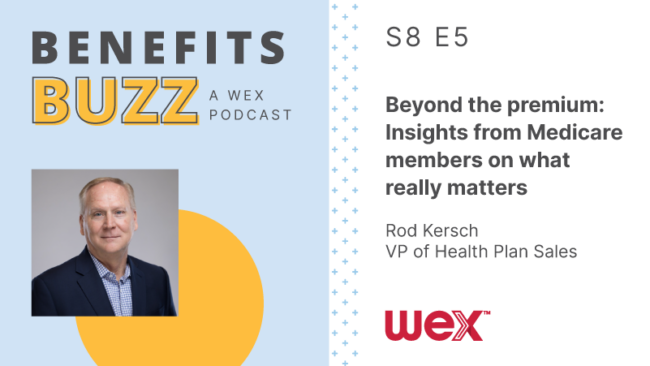
As more employees continue working past age 65, HR teams are increasingly pulled into conversations about Medicare—how it works, what it covers, and how workers should navigate their choices alongside employer-sponsored benefits. Understanding what truly drives Medicare decisions can help employers better support aging employees, improve pre-retirement education, and offer a more confident, seamless transition off the employer plan when the time comes.
A recent episode of Benefits Buzz surfaced powerful new insights into Medicare decision-making, based on nearly 3,100 real conversations with members across the country. We explored real-world perspectives gathered from people who use Medicare every day, with the goal of uncovering the “why” behind their decisions—looking beyond premiums to understand what truly drives enrollment, retention, and satisfaction. Check out our episode with Rod Kersch, vice president of health plan sales at WEX, who shared exclusive findings collected through thousands of conversations with Medicare members nationwide.
Kersch explained that the inspiration for his research dates back to 2015–2016, when it became clear to him that most new ideas in Medicare were generated internally by plans or vendors—not by the members they were meant to serve.
So in 2021, he took a bold new approach. He traveled the country in a camper, gathering “uninhibited, real-world data” by talking with people around campfires. The informal setting encouraged honest conversation, offering what he believes is the “purest way to get people to talk freely.”
One of the industry’s biggest assumptions is that affordability is the primary driver of Medicare plan selection. But Kersch’s conversations revealed something different: members often confuse price (their premium) with true cost (the financial risk they carry). A low-premium plan can quickly become extremely expensive if the wrong healthcare event occurs.
Compounding the issue is a significant education gap. Kersch shared more than 80% of members rely on a broker, agent, or friend for advice—and many make decisions after answering fewer than 10 questions. This lack of engagement in their own decision-making underscores the importance of better Medicare education.
Another key insight: seniors are not one single group.
Many people around retirement age don’t see themselves as “retirees.” Many are still active, prioritizing benefits such as vision. Meanwhile, older members typically value dental, hearing, and OTC coverage more highly.
Kersch emphasized that plans should segment seniors based on their “life formula” and personalize benefits accordingly.
One of the most powerful takeaways involved the emotional and social needs of older adults. Kersch shared the story of a WWII veteran who became energized and joyful after two evenings of social interaction at the campsite.
The experience highlighted the profound impact of social isolation—and the importance of creating opportunities for seniors to connect.
Most of the members interviewed described Medicare as “okay at best.” To improve member satisfaction and financial stability, Kersch suggests focusing on reducing members’ overall cost of living, especially as inflation strains fixed incomes.
WEX is partnering with him to explore programs that offer rebates or discounts on everyday goods to help seniors stretch their dollars further—allowing more room to manage healthcare costs.
Despite assumptions that seniors crave digital-first or cutting-edge benefits, the research found the opposite: members overwhelmingly want stronger, more affordable versions of the “big four” supplemental benefits:
Kersch challenges plans to collaborate with retailers and manufacturers to deliver more offerings at lower costs, helping members maximize their dollars.
He also predicts that the next 24–36 months could be unusually turbulent, with millions of seniors potentially displaced as Medicare plans rebalance their markets.
The research revealed exceptionally high trust in brokers—over 82% of members rated theirs an eight or higher on a 10-point scale. The trust bridge is already built; the challenge is ensuring brokers have the right education and incentives to guide members through a more thorough, personalized enrollment process.
For Kersch, the most important takeaway from the 3,100 conversations is simple: members need to feel informed and involved. And he plans to continue these conversations for the next several years to ensure health plans have access to current, authentic, member-driven data.
Don’t forget to check out our interview with Rod Kersch to learn even more from his conversations with Medicare members!
The information in this blog post is for educational purposes only. It is not legal or tax advice. For legal or tax advice, you should consult your own legal counsel, tax and investment advisers.
WEX receives compensation from some of the merchants identified in its blog posts. By linking to these products, WEX is not endorsing these products.