


Stay connected
Subscribe to our Inside WEX blog and follow us on social media for the insider view on everything WEX, from payments innovation to what it means to be a WEXer.
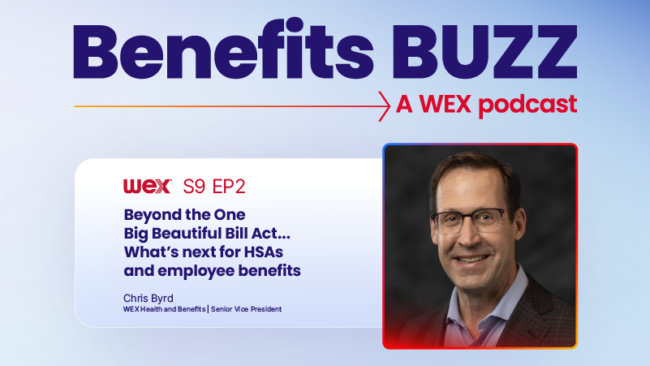
The One Big Beautiful Bill Act continues to shape the employee benefits world. In a recent episode of the Benefits Buzz podcast, Chris Byrd, WEX health & benefits senior vice president, shared his insights on what has changed since the legislation passed. He discussed key health savings account (HSA) updates, other important employee benefits provisions, the growing interest in ICHRAs, and the trends employers should watch as they plan for the future.
According to Byrd, the most important development isn’t a dramatic policy change—it’s certainty.
Following the bill’s passage, regulators have released guidance that clarifies how employers can implement the law. That means organizations can now evaluate their benefit strategies with greater confidence and begin planning for upcoming enrollment seasons.
Rather than reacting to legislative uncertainty, employers can focus on optimizing their benefit offerings and employee experience.
HSAs remain one of the most valuable tools for managing healthcare costs and building long-term financial wellness. The legislation expands both access to HSAs and the ways employers can pair them with other benefits.
Employers can now permanently offer first-dollar telehealth coverage without jeopardizing HSA eligibility.
Previously, many employers worried that covering telemedicine before the deductible could disqualify employees from contributing to an HSA. That concern is gone.
This gives employers more flexibility to encourage employees to use lower-cost virtual care while preserving the tax advantages of HSAs.
Employees enrolled in direct primary care (DPC) arrangements can maintain HSA eligibility.
This opens the door for employers interested in supplementing traditional health plans with DPC memberships as part of their benefits package.
All Bronze and Catastrophic plans purchased in the individual market are now automatically HSA-eligible.
While this may not seem directly relevant to employer-sponsored plans, it significantly increases the value of individual coverage HRAs (ICHRAs), allowing employees purchasing individual coverage to pair lower-cost plans with an HSA.
One of the fastest-growing conversations in employee benefits centers on ICHRAs.
Instead of sponsoring a traditional group health plan, employers contribute a fixed amount of tax-advantaged dollars that employees use to purchase their own health insurance.
Why the growing interest?
Small employers continue to face rising healthcare premiums while often lacking dedicated HR or benefits staff. An ICHRA can simplify administration while helping employers continue offering meaningful health benefits.
For employers already providing group coverage, ICHRAs can also help expand benefits to employee populations that may not currently receive coverage, such as:
The flexibility allows employers to maintain group coverage for full-time employees while extending benefits to additional segments of their workforce.
The legislation also increases the dependent care flexible spending account contribution limit from $5,000 to $7,500.
While employers aren’t required to adopt the higher limit, many may choose to do so to better reflect today’s childcare costs.
One consideration remains: non-discrimination testing. Industry groups continue working with the IRS to simplify these rules so employers can more easily offer the higher contribution limit.
Another new benefit generating interest is the introduction of Trump Accounts.
Designed to encourage long-term investing for children, these accounts function similarly to retirement savings vehicles, allowing investments to grow tax-free over time.
For eligible newborns, the federal government provides a $1,000 seed contribution, but families with older children are also opening accounts without receiving the government funding.
At this stage, however, the market is still developing.
Financial institutions are beginning to offer Trump Accounts, and employers have the option to contribute on behalf of employees’ children or facilitate payroll deduction contributions. Operational processes (including account transfers and rollovers) are still evolving, making this an area worth monitoring rather than rushing into.
Beyond legislative changes, one of the biggest conversations in employee benefits today is how employers manage coverage for GLP-1 medications.
These medications have become increasingly popular but also present significant cost challenges.
Some employers are exploring alternative funding strategies, including carving GLP-1 medications out of traditional pharmacy benefits and instead reimbursing employees through HRAs.
This approach may allow employers to:
As this market evolves, employers will continue looking for sustainable ways to balance employee access with affordability.
Artificial intelligence is also changing how employees interact with their benefits.
Rather than simply digitizing enrollment, AI is beginning to help employees:
For employers, better decision support could lead to higher engagement, improved employee satisfaction, and better use of available benefits.
Perhaps the biggest takeaway wasn’t about legislation at all. Benefits communication shouldn’t begin and end during open enrollment.
By the time employees finish choosing health plans, many are overwhelmed and simply stop paying attention. That means valuable benefits (such as HSAs, voluntary benefits, or wellness programs) often receive far less consideration than they deserve.
Instead, employers should think about benefits communication as an ongoing conversation.
Successful organizations:
For example, employees can change HSA contribution amounts at any point during the year. Reminding them after receiving a bonus, tax refund, or life change may be far more effective than mentioning it during an already crowded enrollment period.
The benefits landscape appears relatively stable heading into 2027, giving employers an opportunity to focus less on reacting to legislation and more on building thoughtful, employee-centered benefit strategies.
Whether that means expanding HSA offerings, evaluating ICHRAs, monitoring emerging benefit options like Trump Accounts, or investing in better employee communication, the organizations that succeed will likely be those that continually educate and engage their workforce.
In employee benefits, strategy matters, but communication is what ultimately drives participation and value.
Don’t forget to check out our podcast episode to learn more about the One Big Beautiful Bill Act.
Copyright ©2026 WEX Inc. All rights reserved. The information in this document is subject to change without notice.